

Teeth whitening: In-office or at home? Differences, indications and clinical safety
May 2025 | Dental Aesthetics
What is tooth whitening?
Tooth whitening is a clinical procedure with an aesthetic purpose, which allows the color of natural teeth to be lightened through the controlled application of whitening agents.
It is indicated for the removal of extrinsic stains (caused by food, tobacco, pigmented drinks) and to even out tooth tone in cases of gradual darkening over time.
This is a non-invasive procedure that is in high demand due to its predictability, accessibility and visible results.
There are two main types of tooth whitening carried out under medical supervision:
- - In-office bleaching
- - Outpatient bleaching (at home)
The choice between one and the other depends on multiple clinical factors, aesthetic expectations, patient history and lifestyle.
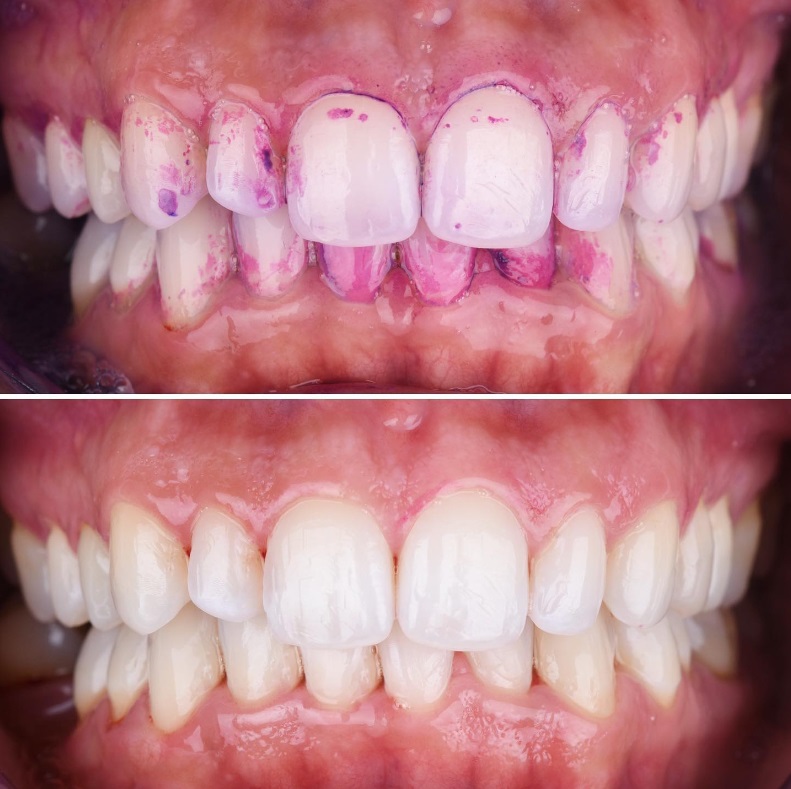
In-office teeth whitening
This type of whitening is carried out exclusively in the clinic, under the responsibility of the dentist, with the direct application of more concentrated whitening agents. The procedure may include LED light activation to enhance the gel's effectiveness.
Indications:
- - Need for immediate results
- - Generalized tooth staining
- - Preference for a controlled protocol from start to finish
- - Patients with a history of sensitivity (increased clinical monitoring)
Advantages:
- - Results often visible after 1 or 2 sessions
- - Protection of gingival structures and soft tissues
- - Precise and supervised technical application
- - Real-time adjustment according to enamel response
Outpatient teeth whitening (at home)
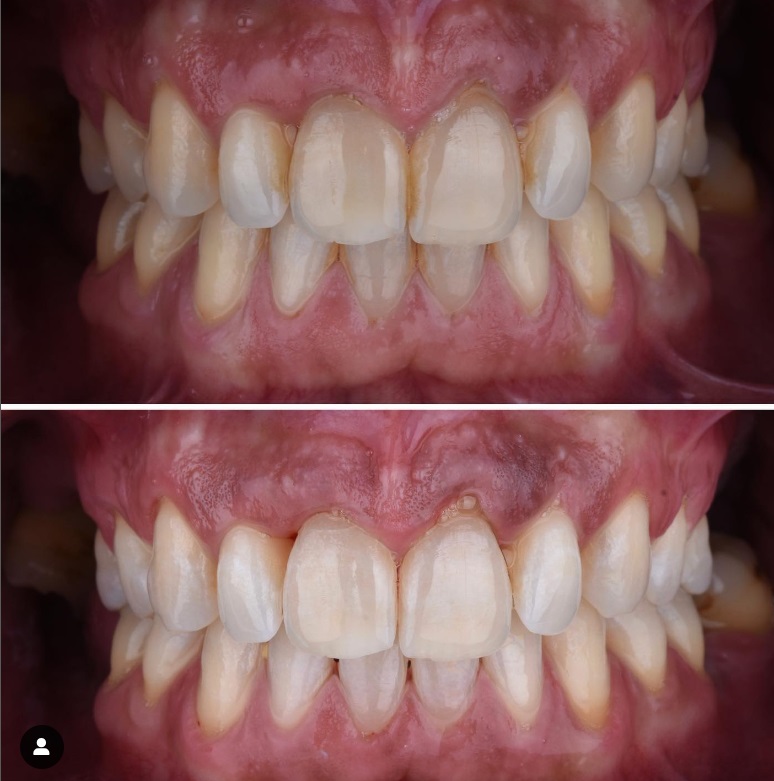
In this protocol, the patient undergoes treatment at home, with customized drops and the application of a whitening gel (usually carbamide peroxide between 10% and 16%). The plan of use is defined by the dentist, depending on the clinical objective.
Indications:
- - Slight to moderate staining
- - Good adherence to the protocol and discipline in the use of drips
- - Maintenance after previous in-office treatment
- - Preference for a progressive process
Advantages:
- - Flexibility and autonomy in application
- - Gradual and comfortable treatment
- - Generally more economical
- - Possibility of controlled periodic repetition
The importance of medical assessment
Tooth whitening should always be preceded by a detailed clinical examination:
Identify contraindications (hypersensitivity, fissures, cervical lesions, active caries)
Assess the type and origin of the discoloration
Ensure the absence of periodontal infections or gum inflammation
Define the ideal protocol and adjust the type of whitening agent to the clinical case
The use of unsupervised kits (online or direct sales) is not recommended due to the risk of:
- - Enamel damage
- - Gum inflammation
- - Exacerbated sensitivity
- - Asymmetrical or unsatisfactory results
Care after tooth whitening
In order to maintain the results obtained and minimize the risk of pigment recurrence, the patient must follow some precautions in the following 48 to 72 hours:
- - Avoid coffee, tea, red wine, dark soft drinks and foods with colorings
- - Avoiding tobacco
- - Maintain strict oral hygiene with a soft toothbrush and neutral toothpaste
- - Avoid abrasive toothpastes
- - Regular oral hygiene to maintain tone
How often can it be done?
Teeth whitening, when carried out under medical supervision, does not compromise the integrity of the enamel or the dental pulp.
It can safely be repeated every 12 to 18 months, depending on the patient's eating habits and clinical response.
Conclusion
At Clínica Raiz, we carry out all tooth whitening procedures according to strict clinical protocols, certified products and permanent medical monitoring.
We assess each case individually, define the most suitable method and monitor the treatment from start to finish, guaranteeing effectiveness, predictability and safety.
Tooth whitening, when carried out correctly, is a safe aesthetic treatment with visible results and a positive impact on dentofacial aesthetics.
The choice between the in-office or outpatient protocol will always be guided by the clinical situation and expectations of each patient.
If you are looking for a natural, stable result that is done with clinical criteria, Clínica Raiz guarantees a personalized approach based on the best scientific evidence available.

Dr. Pedro André, OMD 6318
Doctor Dentist